The Honor Code by Kwame Anthony Appiah
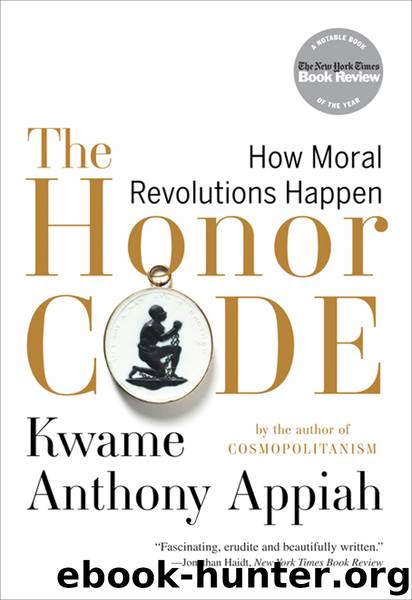
Author:Kwame Anthony Appiah
Language: eng
Format: epub
Publisher: W. W. Norton & Company
Published: 2010-07-27T16:00:00+00:00
A NEW WORKING CLASS
We can begin by recalling a few elements of the story that the great British historian E. P. Thompson told of The Making of the English Working Class. The disputes over the suffrage, which were the background to the Wellington-Winchilsea duel, took place in an atmosphere of intense competition among the aristocracy, the middle classes, and the poor. The beginnings of the trade union movement, inspired by the Jacobinism of the last decades of the eighteenth century, had produced, by way of reaction, the Combination Acts of 1799 and 1800. Their aim was to prohibit such unions and their effect was to drive much radical middle-and working-class organization underground. When the Combination Acts were repealed in 1824, the newly legitimate unions almost immediately organized strikes that alarmed the Tories under Lord Liverpool and their friends in business. Hence the second quarter of the nineteenth century begins with the passage in 1825 of a new Combination Act.
In the early 1790s, artisans and workingmen joined a sprinkling of other radicals to form what they called “Corresponding Societies” in the cities and towns of England. Modeled on the Committees of Correspondence of the American Revolution—which recorded and distributed the decisions of various groups to like-minded fellows—they were central in articulating the need for political transformation. Beginning with the London Corresponding Society in 1792, they made the reform of Parliament and the extension of the suffrage their first order of business; and they were among the first victims of the earlier Combination Acts. In the agitations that led to the Great Reform Act of 1832, their successors managed to gather huge crowds to campaign for change.
In 1830, the Birmingham Political Union drew some 15,000 people to its founding meeting; by 1832 and the week of rioting between May 9 and May 15 when England seemed to be on the brink of revolution, pro-reform organizations were able to draw crowds of a couple of hundred thousand. Meetings such as these added to the pressure that led to these first parliamentary reforms; Parliament got used to the novel idea that it might respond to—rather than direct—the nation’s judgments. This was not a precedent that conservatives thought wise. As Disraeli was to write later of the whole process of abolition, “an enlightened aristocracy who placed themselves at the head of a movement which they did not originate, should have instructed, not sanctioned, the virtuous errors of a well-meaning but narrow-minded community” and the well-meaning community he had in mind was, as he said, the “middle classes.”35
But the Great Reform Act, which received the royal assent in June of 1832, was a significant disappointment to those who hoped to see the enfranchisement of the working classes; indeed, since the new property qualifications excluded anyone who did not own or lease land worth at least ten pounds, it was, from this point of view, no reform at all. The Great Reform defined working-class identity, in part, through reaction—as the status of those the reform did not reach.
Download
This site does not store any files on its server. We only index and link to content provided by other sites. Please contact the content providers to delete copyright contents if any and email us, we'll remove relevant links or contents immediately.
| Anthropology | Archaeology |
| Philosophy | Politics & Government |
| Social Sciences | Sociology |
| Women's Studies |
The remains of the day by Kazuo Ishiguro(9004)
Tools of Titans by Timothy Ferriss(8403)
Giovanni's Room by James Baldwin(7352)
The Black Swan by Nassim Nicholas Taleb(7137)
Inner Engineering: A Yogi's Guide to Joy by Sadhguru(6799)
The Way of Zen by Alan W. Watts(6621)
The Power of Now: A Guide to Spiritual Enlightenment by Eckhart Tolle(5789)
Asking the Right Questions: A Guide to Critical Thinking by M. Neil Browne & Stuart M. Keeley(5779)
The Six Wives Of Henry VIII (WOMEN IN HISTORY) by Fraser Antonia(5519)
Astrophysics for People in a Hurry by Neil DeGrasse Tyson(5196)
Housekeeping by Marilynne Robinson(4455)
12 Rules for Life by Jordan B. Peterson(4312)
Double Down (Diary of a Wimpy Kid Book 11) by Jeff Kinney(4278)
Ikigai by Héctor García & Francesc Miralles(4278)
The Ethical Slut by Janet W. Hardy(4262)
Skin in the Game by Nassim Nicholas Taleb(4256)
The Art of Happiness by The Dalai Lama(4133)
Skin in the Game: Hidden Asymmetries in Daily Life by Nassim Nicholas Taleb(4012)
Walking by Henry David Thoreau(3968)
